Satya Nadella, "Empathy is Our Superpower": The Story That Rebuilt Microsoft
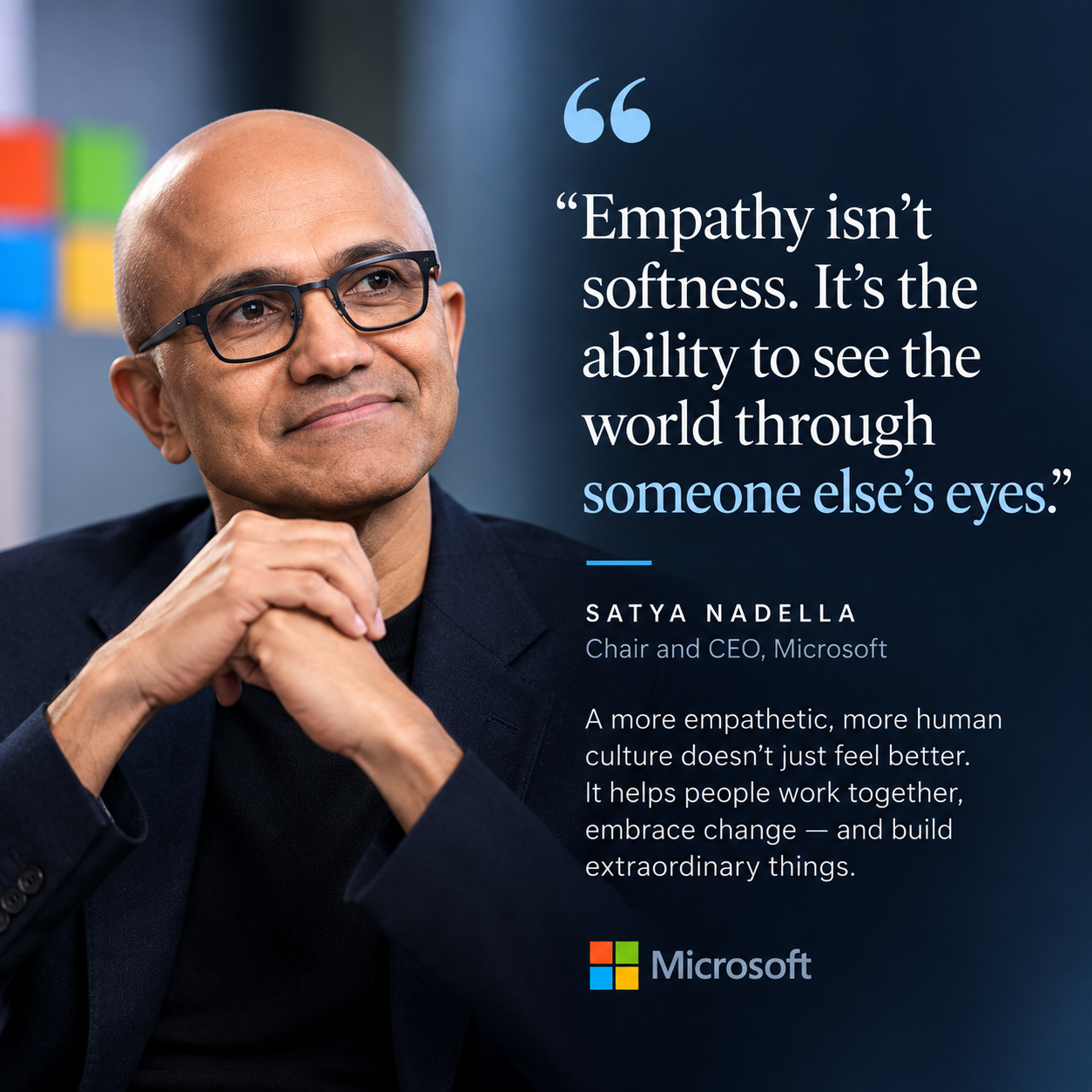
How Satya Nadella's most personal experience as a father — raising his son Zain who could not walk or speak — cultivates empathy as a superpower that scaled Microsoft from $300 billion to $3 trillion. A case study in the signature leadership story, read through the A.R.C.
When Satya Nadella took over as Microsoft's CEO in February 2014, the company was worth around $300 billion and had lost its spark. A decade later, it crossed $3 trillion in market value. Most accounts credit the cloud, the success of Microsoft Surface, or the bet on AI. All of these are true. But underneath the strategy sits something far more personal — a lesson Nadella learned not in a boardroom, but at a hospital bedside, as a father. This is the story of how the lessons in empathy from Satya's deeply profound journey as a father became embedded in Microsoft's operating system. It is a near-perfect example of what we at 10 Nexus call a signature leadership story: the true, personal narrative that carries a leader's presence, message, and their powerful why.
We read this story through our own framework — the A.R.C.: Awareness (the world as it was), Revelation (the moment it changed), and Commitment (who he chose to become). The power of any leadership story is never only in what happened. It is in who the leader became because of what happened.
A — AwarenessThe world as it was
By 2014, Microsoft had become a cautionary tale about its own success. Inside, it was known for a cutthroat, hyper-competitive culture — one so internally fractured it was captured in a now-famous org-chart cartoon showing each division pointing guns at the others. "Stack ranking" pitted colleagues against one another. Meetings rewarded whoever looked like the smartest in the room. Presentations were data-dumps and feature slides. The company that had helped democratize computing had, over time, buried its own soul under bureaucracy and internal politics.
This was the world Nadella inherited: brilliant, dominant, and quietly stagnant. A culture of what he would come to call know-it-alls.
R — RevelationThe moment it changed
The revelation had come eighteen years earlier, and it had nothing to do with software.
In August 1996, Nadella's first child, Zain, was born after suffering in-utero asphyxiation — a loss of oxygen before birth — that resulted in severe cerebral palsy. Zain would use a wheelchair and require care for his entire life. In his best-selling memoir Hit Refresh, Nadella writes openly about how hard those early years were, and — more tellingly — about his own first reaction: self-pity. He wondered how this would alter his plans, his life.
What shifted him was watching his wife, Anu, set her own life aside to care for their son. As he later shared on the Microsoft accessibility blog, it reframed everything:
"Nothing happened to me; something happened to Zain."— Satya Nadella, on the turning point in his life (Hit Refresh)
He had to step up, he says, and be the father. That single reframing — moving out of his own ego to see the world through his son's eyes, and his wife's — became the seed of everything that followed. Writing for Knowledge@Wharton and speaking at Stanford Graduate School of Business, Nadella has described becoming Zain's father as the experience that gave him a deeper capacity to see things as others see them. It became, quite literally, his working definition of empathy.
"The power isn't in what happened. The power is in who you became because it happened."
From coping mechanism to strategy
Here is where a moving personal story becomes a leadership story. He came to argue that empathy is not a soft skill at all — in fact, he calls it the hardest skill we ever learn — and the ultimate source of innovation. You cannot uncover the unmet, unarticulated needs of the people you serve, he believes, without first being able to feel your way into their experience. Empathy is how you find the problems worth solving.
That conviction had teeth. Caring for Zain gave Nadella a personal stake in accessibility, and under him it stopped being a compliance checkbox and became an engineering standard. The result was a wave of genuinely life-changing technology: the Xbox Adaptive Controller for gamers with limited mobility, Seeing AI for people who are blind or have low vision, and Immersive Reader / Learning Tools for dyslexia built across Windows and Office. Empathy, made into product.
C — CommitmentWho he became — and what he built
As CEO, Nadella set out to rewrite the company's cultural playbook using the very qualities fatherhood had taught him: patience, adaptation, and attention to others. He asked Microsoft to trade know-it-all for learn-it-all — borrowing psychologist Carol Dweck's growth mindset and, crucially, wiring it into how the company actually operated:
Behind all of it was a belief Nadella states plainly: the "C" in CEO stands for culture. A leader's first job, he argues, is to be the curator of an environment where innovation can bubble up — not to dictate it from the top.
The part that fascinates me most: he made it a storytelling culture
Before Nadella, Microsoft's stories were about technical superiority and market share. Under him, the narrative turned toward human capability. And he led by example — sharing his family's story publicly, on the accessibility blog and in Hit Refresh. In doing so he triggered what researchers call a vulnerability loop: when a leader goes first, others get permission to bring their whole selves to work, and to tell their own stories.
One anecdote became internal lore. Visiting Zain in intensive care, Nadella looked around and realized the medical monitors keeping his son alive were running Windows, connected to the cloud. Technology wasn't abstract. It was a lifeline. That image — code as something that touches a human life — became a touchstone for Microsoft's engineers.
The company went further and institutionalized storytelling. It built a program called Storytelling for Champions to teach people across the organization to turn change into human stories rather than relying on features, facts, and corporate directives. Champions are trained on a punchy four-part structure — the everyday, business cousin of a personal A.R.C.:
Why does this drive results? Because people buy into shared experience far more easily than they buy into mandates. When a change arrives as a human story, resistance drops and adoption speeds up. Feature-dumping became human outcomes; stack-ranked silos became teams learning out loud from each other's failures. That is what a story culture actually does — and it is a large, under-credited part of how a stagnant giant became one of the most valuable companies on earth.
Empathy, applied even to strategy
The same humility showed up in how Nadella ran the business. In Hit Refresh he frames innovation across three horizons — protecting the core (Windows, Office), scaling proven growth engines (Azure), and investing early in the unproven future. In 2017 he placed artificial intelligence in that third, far horizon.
What he did next is a masterclass in what he calls co-opetition. Rather than trying to invent everything in-house, Microsoft made its first billion-dollar investment in OpenAI in 2019 — long before generative AI was a household phrase — giving OpenAI the Azure compute to train its large models, and giving Microsoft the inside track on the most advanced AI of the era. AI leapt from Horizon 3 to Horizon 2 to the very core of every product under the Copilot brand. Nadella discusses that partnership and its future in this Bloomberg conversation:
The strategic lesson mirrors the personal one: the humility to admit you cannot do it all alone. Empathy and ego-restraint, it turns out, are not only how you parent. They are how you compete.
The thread
Empathy alone does not explain Microsoft's transformation — the cloud, the timing, the OpenAI bet, and thousands of people's work all matter. Yet we can trace a clear thread through this leadership philosophy, and how it applies to empowering Microsoft's Culture and Leadership at all levels:
Experience → Empathy → Leadership → Culture.
Our leadership philosophies rarely begin as philosophies. They begin as experiences and crucicle moments. A significant shift happens. Someone challenges us. We fail. We cross a border. We lose something, and discover something fundamental about ourselves. And eventually, that experience hardens into a belief or philosophy about how we want to show up in the world.
That is a leadership story. And it has a shape — the one we've followed all the way through Satya's:
Nadella's story is worth studying not because it is famous, but because the thread is so visible in it. A father's reckoning became a definition of empathy; a definition of empathy became a culture; a culture became a company worth three trillion dollars. Experience, all the way up.
Now — what about yours?
There may be an experience in your life you've never thought of as a "leadership story." Perhaps you moved and immersed yourself in a new culture. Started again somewhere new. Had someone believe in you. Built something you truly believed in, and put in 200%. This is the story behind the company you've built, the mission you dedicate yourself to, the back story of the community you start, the stories that bind the members of the team you lead.
This is the kind of authentic leadership story only you can tell, in your own voice. And it is one of the most underused, yet most powerful tools in your leadership toolkit.
Find the signature leadership story only you can tell
Take our free 5-minute quiz to discover your signature leadership story type — then download the Field Guide to begin shaping it.
Take the quiz → Get the Field GuideCome find the signature leadership stories only you can tell, in your own voice.
Satya Nadella, Hit Refresh (2017) · Microsoft Accessibility Blog, "The moment that forever changed our lives" · Knowledge@Wharton · Stanford GSB · Fortune · Inc. · Chicago Booth Review · CNBC (market cap) · CNBC (OpenAI) · Microsoft Adoption: Storytelling for Champions · Bloomberg Talks (video). This piece analyzes and interprets these public sources through the 10 Nexus A.R.C.™ framework.
10 Nexus — Empower Voices. Transform Leaders. Shape Our Global Home.
Empower Circles · stories.10nexus.com